What Is Fluency and How Do I Support It in the Classroom? - WeAreTeachers
What is fluency?
While the discussion has several meanings, when it comes to education, teachers are most oft referring to reading fluency.
Reading adept Tim Rasinski defines a fluent reader as one who reads accurately, at an appropriate rate, and with attention to phrasing and expression.
You've likely experienced listening to a halting, stumbling reader read aloud. Information technology's hard to sit through, especially because you know that the student is experiencing every bit much, if not more, discomfort than you are. Researchers accept recognized reading fluency as a key aspect of proficient reading for a while now, just some experts express lingering concerns that fluency educational activity continues to be misunderstood or neglected.
Below, nosotros've pulled together resources to help you further understand what is fluency and to back up your students in each of its critical components.
Improving Reading Accurateness
When students more accurately decode or recognize words, their fluency improves. Effort these strategies:
one. Comprise multi-sensory phonics and sight give-and-take learning strategies into your teaching
Emily at The Literacy Nest shares smashing ideas for teaching sight words in a multi-sensory and systematic way. We too love how she repurposes old-school games for phonics review.

SOURCE: The Literacy Nest
2. Integrate phonics into content surface area and bookish vocabulary teaching for older students
When you unpack the phonetic elements of words like revolution or ecosystem, students get an extra dose of decoding support. AdLit.org shares details.
3. Teach roots, prefixes and affixes
When students are familiar with these common discussion parts, they can tackle multisyllabic words more efficiently. ReadWriteThink has an exhaustive list of roots, prefixes, and affixes and offers many related resources for classroom activities. The Dark-brown Bag Instructor has an crawly round up of online resources and activities for education Greek and Latin roots.
Improving Reading Rate
The optimal reading rate is not too wearisome or too fast. Strong readers vary their charge per unit to support comprehension. These strategies can help your students notice the right residual between tortoise and hare:
1. Try repeated readings of poetry
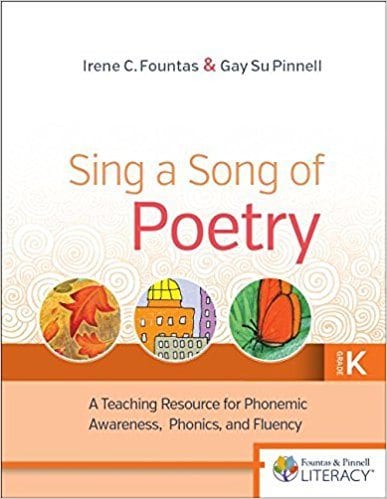
Lori Oczkus and Tim Rasinski suggest repeated readings of poetry to help with rate and automaticity in this ILA blog post. To find poems for younger students, look to the newly revised editions of Fountas and Pinnell's Sing a Song of Poesy: A Teaching Resource for Phonemic Sensation, Phonics, and Fluency. Upper form teachers love Kenn Nesbitt'south Poetry4Kids site.
2. Read song lyrics
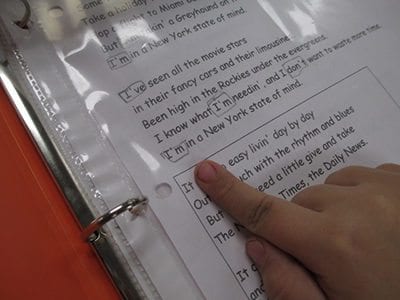
For some other fun approach to repeated reading, effort having students read song lyrics along with the music, as described by Shari Edwards of the Scholastic Superlative Teaching Blog. Are you bustling yet?
SOURCE: Scholastic Top Teaching Web log
3. Use simple apps and basic features of an iPad
Nosotros love the ideas for using uncomplicated apps and basic features of an iPad to assistance students practice reading at an appropriate rate shared on Erin*tegration. Subsequently all, Siri can help with almost anything—if you read questions to her fluently.
iv. Practise a speed reading claiming
Of form, some students merely desperately need to channel their inner hare. Help slow readers proceeds automaticity with speed reading challenges. The Florida Center for Reading Inquiry offers a full line-upwards of syllable-reading resources . Or, simply impress the Dolch sight words on flashcards. Have students keep track of how many they tin read correctly in ane minute and effort to beat previous scores.
Improving Phrasing and Expression
Anyone who's had the pleasance of listening to a truly expressive reader knows how it can transform a text. Check out these teacher-tested ideas for improving students' prosody:
1. Teach fluency-related mini lessons
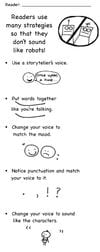
Danielle Mahoney of the Scholastic Top Didactics Blog offers a fantastic list of lessons including, "Put Words Together Like Talking," "Change Your Voice to Friction match the Mood," and "Notice Punctuation and Lucifer Your Voice to It." Download her handy bookmark, too!
SOURCE: Scholastic Elevation Didactics Blog
2. Stage regular readers' theater productions
No demand to reinvent the wheel; in that location's a solid research base for the benefits of readers theater. Bookmark this round-up of ideas for finding scripts.
three. Have students record their own reading
This can be as simple as using the Vocalisation Memos iOS app. When students listen to themselves read, they can reflect on aspects of fluency that need improvement and re-tape to endeavor again. Teachers also dear the podcast app AudioBoom. EdSurge provides a helpful tutorial.
Assessing Fluency
Of form, cess is a key piece of both determining students' fluency needs and tracking progress. Bookmark these resources:
1. Endeavor timed readings
A traditional arroyo for assessing fluency is a timed reading to obtain a words correct per minute charge per unit (WCPM). Reading Rockets sums up this practice nicely using a repeated reading model.
2. Make apply of fluency apps
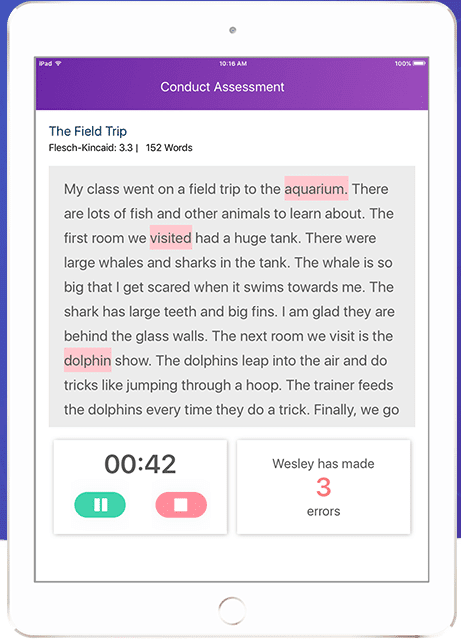
If you're frustrated with the logistics of juggling a student text, recording sheet, pencil and timer, bank check out ThinkFluency, a new app that saves teachers tons of time. Using the provided passages or ones you lot upload yourself, you lot tin can input student errors on your tablet or phone as a student reads and permit the app automatically time and score the assessment. Win! The app also provides suggestions for phonics instruction based on mistake patterns and allows you to track student information over fourth dimension.
SOURCE: ThinkFluency.com
three. Use rubrics
Rubrics are ideal for evaluating students' phrasing and expression. There are many available online, but we like this i from Duke University.
What are your favorite tips and tricks for supporting students' reading fluency? Come and share in our WeAreTeachers HELPLINE group on Facebook.
Plus, don't miss our gratis fluency posters and ballast chart ideas.
Source: https://www.weareteachers.com/what-is-fluency/
0 Response to "What Is Fluency and How Do I Support It in the Classroom? - WeAreTeachers"
Post a Comment