How to Change Font Family of a Button Html
The author selected the Diverseness in Tech Fund to receive a donation as function of the Write for DOnations program.
Introduction
Cascading Style Sheets (CSS) is a language designed for two disciplines: that of the programmer and that of the designer. Working with text on the web is i of the clearest examples of this broad accessibility to the language. Styling text uses concepts from the graphic design world but adjusts naming conventions to exist more broadly implemented.
In this tutorial yous volition larn about web typography, the fine art of styling text. Similar to working with a press press, you volition set out your content, apply visual manner to aid communicate the content, and adapt the content for legibility and emphasis. The intent with styling text on the web is to create a visual hierarchy through colour, size, shape, and space. This way, headings stand out from sub-headings, which stand out from paragraphs. These concepts help make text more readable and scannable for readers.
You lot volition showtime the tutorial by writing the HTML structure, which will consist of placeholder content from Cupcake Ipsum. You will piece of work with different heading levels (h1-h6) and content types (p, stiff, and em) to utilise multiple text-related CSS properties, including font-family, font-size, and colour. You will as well load custom fonts from Google Fonts, a third-party font-hosting service. Each stride of this tutorial will introduce a new concept or set of backdrop to apply to the content. Past the cease you lot will have a custom-styled web page.
Prerequisites
- An HTML file saved on your local machine equally
alphabetize.htmlthat you can access from your text editor and web browser of choice. To get started, check out our How To Prepare Your HTML Project tutorial, and follow How To Use and Sympathise HTML Elements for instructions on how to view your HTML in your browser. If you're new to HTML, try out the How To Build a Website in HTML serial.
Setting Up the Example HTML
In this first footstep you will ready up the HTML that you volition style throughout the residuum of the tutorial. The purpose of the HTML in this tutorial is to provide diverse elements and situations for you lot to practice styling.
Open up the index.html file using a text editor, such as nano, Vim, or Visual Studio Code. Add the following boilerplate HTML to requite the file necessary baseline lawmaking:
index.html
<! doctype html > <html > <head > <link href = "styles.css" rel = "stylesheet" /> </head > <body > </trunk > </html > The <link /> element already loads in the styles.css file, so be sure to have that file ready too.
Adjacent, yous need some content to style. When creating text styles, often a project needs styles before the content is gear up. In the graphic design world, placeholder content is used for this purpose. Designers will oft use Latin text equally a placeholder, known as Lorem Ipsum. There are many modern renditions of this placeholder text, including Cupcake Ipsum. This volition be the reference copy used throughout the HTML.
To start, the HTML needs to depict hierarchy, a articulate distinction and lodge of content. In HTML that is done with heading tags, which span from <h1>, the peak most heading, through <h6>, the lesser virtually heading. The browser default styles for the headings define the visual bureaucracy by size alone, with the <h1> chemical element'due south default font-size being significantly larger than that of the <h6>. Throughout this tutorial you will utilize other principles of design, such every bit color and space, to provide visual hierarchy to the content.
To create this hierarchical content, you lot will write out various headings and make full each heading with a few words from Cupcake Ipsum within the <trunk> tags in index.html. You volition follow proper HTML semantics, which provide authentic significant to the browser.
To take proper HTML semantics:
- At that place will simply be one
<h1>element on the page. This will usually exist the title. - Subsequent heading levels volition just be one bottom, equal, or whatever greater level. For example, the only heading level that comes subsequently an
<h3>volition be either<h4>, some other<h3>, or an<h2>, but never an<h5>or<h6>.
With the rules of heading semantics, add the following highlighted HTML to index.html:
index.html
... <torso > <h1 > Sugar plum chupa chups chocolate bar cupcake donut </h1 > <h2 > Tootsie scroll oat block macaroon </h2 > <h2 > Jelly beans tiramisu pastry danish donut </h2 > <h3 > Lemon drops pastry marshmallow </h3 > <h3 > Apple pie pudding topping </h3 > <h4 > Gingerbread danish </h4 > <h5 > Carrot cake topping lollipop gummi bears </h5 > <h6 > Liquorice bonbon processed cotton candy liquorice </h6 > </body > ... Adjacent, you need some content to fill in space between each heading. These will be paragraphs of text designated by the <p> element to hold each paragraph. Apply Cupcake Ipsum once more to generate this content and identify the paragraphs throughout the page.
Add the highlighted portions of the following code block. This tutorial volition use this format for code blocks throughout:
index.html
... <body > <h1 > Saccharide plum chupa chups chocolate bar cupcake donut </h1 > <h2 > Tootsie roll oat cake macaroon </h2 > <p > Jujubes brownie candy. Dessert tootsie coil pie gummi bears danish cotton wool candy. Carbohydrate plum I love fruitcake pastry. Jelly-o gummi bears muffin gummi bears marzipan cheesecake donut gingerbread I love. Cupcake wafer cake. </p > <h2 > Jelly beans tiramisu pastry danish donut </h2 > <h3 > Lemon drops pastry marshmallow </h3 > <p > I love marshmallow processed. Sesame snaps muffin danish. Chocolate cake cookie jelly-o tiramisu halvah brownie halvah chocolate chocolate cake. Jelly-o caramels jujubes bonbon cupcake danish tootsie roll chocolate bar. Macaroon I beloved muffin candy canes sweet roll I love. I love bonbon marshmallow croissant ice cream I dearest gummi bears. </p > <h3 > Apple tree pie pudding topping </h3 > <p > Pie apple tree pie I dearest jujubes biscuit I beloved. Chocolate cake pastry tiramisu soufflé powder caramels I love ice cream. Dragée liquorice toffee jelly jelly beans. Sesame snaps candy canes soufflé. Biscuit donut deport hook jujubes halvah pastry macaroon lemon drops. Tootsie roll dragée cookie candy soufflé dragée cupcake liquorice. </p > <h4 > Gingerbread danish </h4 > <p > Powder dragée sesame snaps candy canes jelly-o. Halvah gingerbread cheesecake wafer. Wafer tootsie curlicue I love I love. Cake toffee I love. Cotton candy cotton processed jelly beans I beloved bonbon toffee. Chupa chups chupa chups caramels ice cream halvah processed chocolate cake. Marshmallow carrot cake jelly beans. </p > <h5 > Carrot cake topping lollipop gummi bears </h5 > <p > Chocolate cake sugariness ringlet pudding chocolate block fruitcake bear claw. </p > <h6 > Liquorice bonbon processed cotton candy liquorice </h6 > <p > Cupcake donut topping chupa chups halvah chupa chups. Macaroon tootsie roll cupcake caramels chocolate fruitcake gingerbread jelly-o. Tiramisu I love marshmallow jelly-o I love jelly beans candy gummi bears. </p > </torso > ... Finally, add together in <strong>, <em>, and a combination of the two elements together. This volition provide examples of phrases that are emphasized in the content:
index.html
... <h2 > Tootsie gyre oat block macaroon </h2 > <p > Jujubes credibility candy. Dessert tootsie ringlet pie gummi bears danish cotton candy. Sugar plum <strong > I love fruitcake pastry </stiff > . Jelly-o gummi bears muffin gummi bears marzipan cheesecake donut gingerbread I beloved. Cupcake wafer block. </p > <h2 > Jelly beans tiramisu pastry danish donut </h2 > <h3 > Lemon drops pastry marshmallow </h3 > <p > I love marshmallow processed. <em > Sesame snaps </em > muffin danish. Chocolate cake cookie jelly-o tiramisu halvah brownie halvah chocolate chocolate cake. Jelly-o caramels jujubes bonbon cupcake danish tootsie roll chocolate bar. Macaroon I love muffin processed canes sweet roll I beloved. I love bonbon marshmallow croissant water ice cream I love gummi bears. </p > <h3 > Apple pie pudding topping </h3 > <p > Pie apple pie I beloved jujubes biscuit I dearest. Chocolate cake pastry tiramisu <strong > soufflé powder caramels </strong > I dear ice cream. Dragée liquorice toffee jelly jelly beans. Sesame snaps candy canes soufflé. Biscuit donut bear hook jujubes halvah pastry macaroon lemon drops. Tootsie scroll dragée cookie processed soufflé dragée cupcake liquorice. </p > <h4 > Gingerbread danish </h4 > <p > Powder dragée sesame snaps candy canes jelly-o. Halvah gingerbread cheesecake wafer. <strong > <em > Wafer tootsie roll </em > </potent > I dearest I dear. Block toffee I beloved. Cotton candy cotton candy jelly beans I dearest bonbon toffee. Chupa chups chupa chups caramels ice cream halvah processed chocolate cake. Marshmallow carrot block jelly beans. </p > <h5 > Carrot cake topping lollipop gummi bears </h5 > <p > Chocolate cake sweet roll pudding chocolate cake fruitcake bear hook. </p > <h6 > Liquorice bonbon candy cotton candy liquorice </h6 > <p > Cupcake donut topping <em > <strong > chupa chups halvah </strong > </em > chupa chups. Macaroon tootsie curl cupcake caramels chocolate fruitcake gingerbread jelly-o. Tiramisu I love marshmallow jelly-o I dear jelly beans processed gummi bears. </p > ... Now that you have the HTML written, relieve index.html and open it in your browser to see what the page looks similar with the browser default styles:

The text ranges in sizes across all the elements, with the default <h5> and <h6> styles existence smaller than the <p> text.
In this step yous prepare upward the HTML content that volition exist styled throughout the residual of the tutorial. Next, yous volition piece of work with the font-family property, learn nearly the font stack, a list of fonts that the browser can use, and utilise fonts to different elements.
Using the font-family Belongings
Next, you volition piece of work with the font-family CSS property and load an external font file from the Google Fonts service. The name of this property derives from a typography term that describes the collection of fonts and the variations of that font, including bold and italic versions. A font tin can have many of these variations, but can all be part of the same font-family, with those variations called with font-weight and font-style properties.
To begin working with font-family, information technology is helpful to understand the particulars near its value options. The value of a font-family property is a list of fonts called a font stack. The font stack works as a fallback system. Consider the following font-family property value:
font-family : "Helvetica Neue" , Helvetica, Arial, sans-serif; The browser is first going to decide if Helvetica Neue is available for it to use, either as a font that is installed on the computer or as ane provided by a website. If the browser doesn't detect a font called Helvetica Neue, so information technology goes downward the list to Helvetica and then to Arial. If the browser is unable to find any of those fonts, then the final font in the list, sans-serif, will use whatever the browser has set up equally its default font for a sans-serif style font.
Note: Font stacks provide their all-time feature non when a font is not establish, simply when a particular character is not found in the font. This is specially necessary for instances of using multiple language support, where i font may not have a character set that covers all languages needs. A font stack tin contain a fallback font that provides the special characters and a similar visual feel to the primary font in the stack.
Create a file called styles.css in the aforementioned directory as index.html. Open it upwardly in your text editor and add a default font for the page:
styles.css
torso { font-family : "Avenir Next" , Calibri, Verdana, sans-serif; } In this lawmaking, you kickoff with a trunk type selector with a font–family property. Next, for the font stack you start with "Avenir Next", which will be available on iOS and macOS browsers. Avenir Side by side is in quotes considering the font proper name is 2 words. The side by side font is Calibri for Windows browsers. Be sure to put a comma between each font announcement. To provide a more generic font fallback, yous then use Verdana, which has been widely available on computers since the early 2000s. Finally, since all these fonts are classified as sans serif fonts, you add together the browser default sans-serif as the terminal font option in the font stack.
Salvage styles.css, then open up up index.html in your browser. You will notice a new font in place of the browser default font for the content. If you are on an Apple operating system, Avenir Next volition return in the browser. If you are on Windows, Calibri volition render instead. The following image is what this font stack looks similar on MacOS:

In this section y'all used the font-family belongings to fix up a default font stack for the web page. Yous also prepare up a font-family holding that applies specifically to heading text content. In the adjacent section y'all will use the Google Fonts service to load a custom font file and use it on the page.
Loading Custom Fonts With Google Fonts
At present that you accept used the font-family property with fonts already installed on your reckoner, it is fourth dimension to load fonts from an external service. This volition widen the range of fonts y'all can use to style your text. In this department, you volition work with the Google Fonts service to load and use a font on the spider web page.
Browsers have the ability to load whatsoever font, so long as information technology is provided the appropriate font file format for that browser. A font service, such as Google Fonts, alleviates the work of defining and hosting fonts by providing both the CSS and font files needed to load the font. At that place are many other services similar Google Fonts, only Google Fonts hosts royalty and open up source fonts and offers the service free of accuse.
To become started, open fonts.google.com in you browser.
There are many dissimilar fonts you can cull from in Google Fonts. This tutorial will use two: Public Sans and Quicksand.
From the search field on Google Fonts, search for Public Sans. When the font card shows upwardly from the search result, a preview of the font is displayed. Click the carte du jour to become to the page for the font:
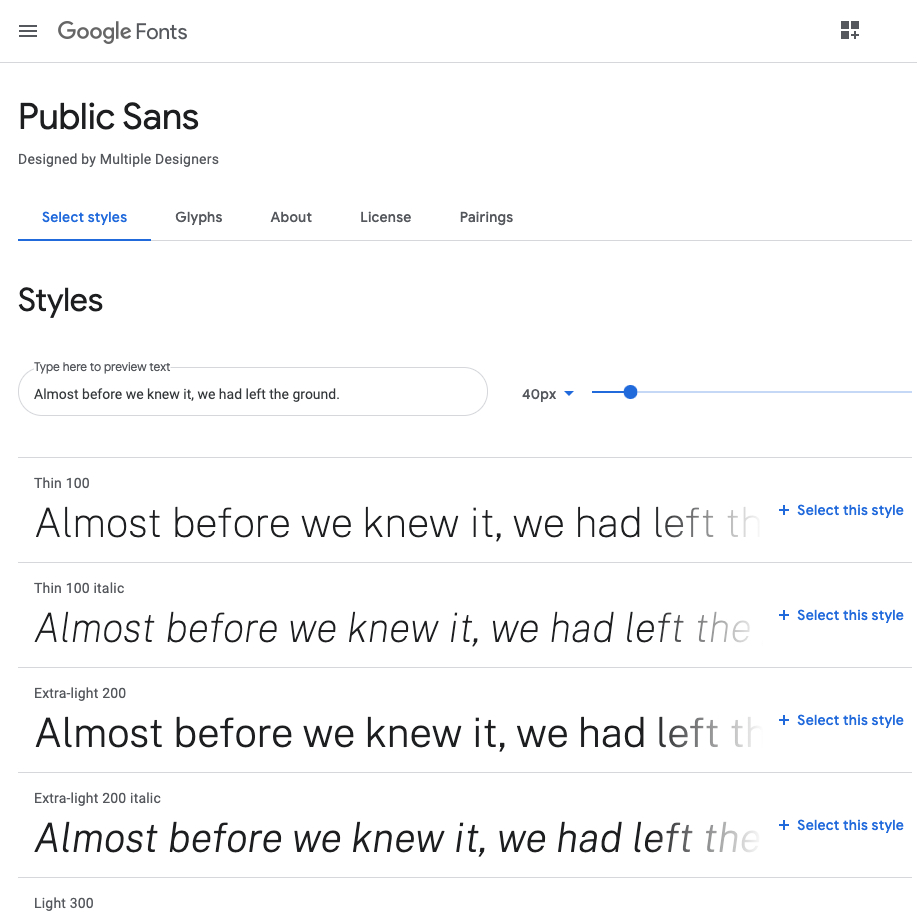
The Public Sans font page will list all the variations of the font. These are known as weights, which range from 100 to 900. For the purposes of this tutorial, find the Regular (400) and the Bold (700) styles and press the + Select this style button side by side to each style variant, as well every bit their italic style.
Once y'all select the first mode, a selected family tool will slide in. This tool volition provide you with the HTML and CSS needed to use these fonts:

Select the <link /> method to load the fonts in the browser and copy the provided HTML. Open up index.html and add the code into the <head> element after the <link /> loading styles.css. Continue Google Fonts open, as you volition return to it a couple more times:
index.html
... <head> <link href="styles.css" rel="stylesheet" /> <link href="https://fonts.googleapis.com/css2?family=Public+Sans:ital,wght@0,400;0,700;1,400;ane,700&brandish=swap" rel="stylesheet"> </head> ... At this point, reloading index.html in your browser won't have any visual changes. The browser is loading the font, merely the font needs to be added to the font stack to employ the font to the content.
Return to Google Fonts to find the CSS rule that loads Public Sans. Google Fonts provides a font stack of Public Sans and the browser default sans-serif font with font-family unit: 'Public Sans', sans-serif;. Since you already accept a font stack set up with fallback fonts, all that you need to accept from Google Fonts' case is the name to reference Public Sans.
Using your existing font stack in styles.css, supercede Avenir Next and Calibri with Public Sans:
styles.css
body { font-family unit : "Public Sans" , Verdana, sans-serif; } Now that the base font stack has been declared all fonts on the page are at present Public Sans.
I common design practice to bring more attention to headings is to use a unlike font for the headings than for the chief text. To apply this to your own HTML, render to Google Fonts and do a search for "Quicksand." This will be the heading, or display font, for the <h1> through <h6> elements on the page.
Once you have institute Quicksand, select the font card and add the Semi-bold (600) and Bold (700) font weights to the selected fonts alongside Public Sans. Google Fonts will provide a new URL to load all the selected fonts and variants. Bandy out the previous href value for the new link in your index.html file:
alphabetize.html
... <head> <link href="styles.css" rel="stylesheet" /> <link href=" https://fonts.googleapis.com/css2?family unit=Public+Sans:ital,wght@0,400;0,700;i,400;1,700&family unit=Quicksand:wght@600;700&display=swap" rel="stylesheet"> " rel="stylesheet"> </head> ... Now that Quicksand is gear up to load in the browser, you need to apply it to the heading tags. You will accomplish this by adding a comma-separated list of CSS selectors, chosen a group selector, to your styles.css file. In this case, use the font stack provided by Google Fonts with Quicksand followed by the browser default sans-serif font:
styles.css
... h1, h2, h3, h4, h5, h6 { font-family : "Quicksand" , sans-serif; } Relieve your changes to styles.css and return to your browser to reload index.html. Feel free to close Google Fonts at this indicate. When the browser loads, you will at present notice two fonts displayed. Quicksand is at present on all the headings and Public Sans is on all other content, including the bold and italic content.

In this section you loaded two fonts from the Google Fonts service and added those fonts to your existing font stacks. The adjacent section will look at using the font variants to specify when and how to apply bold and italic to a font.
Using font-weight and font-style Backdrop
In this section you will use the font-weight and font-style properties to accommodate how a font appears. There are many reasons to use these variations, such as to emphasize content, as part of a commendation style guide, and to provide visual variation.
Now that you are loading in custom fonts from Google Fonts, you lot tin start to fine-tune the characteristics of the text. Starting with the font-weight holding, you can alter how thick or sparse the font is displayed. The font-weight belongings has ii common values: normal and bold. The normal value is the default font-weight for virtually text in a browser. The assuming value is the default font-weight for headings and <strong> elements. Only for this tutorial, you lot will need to use the numeric values instead of the name normal and bold values.
Numeric font-weight values depend on the font that yous are loading. When you added the Public Sans font from Google Fonts, you selected the Regular (400) and the Bold (700) weights. The numbers in parenthesis coincide with the values needed to reference and load that font. Additionally, the font-weight value of 400 is the numerical equivalent of normal, similar 700 is the numerical equivalent of bold. Text that uses Public Sans, which is all but the headings, will automatically utilise these weights.
Alternatively, the Quicksand font selections included the Semi-bold (600) and Bold (700) font weights. The 600 value does not have a numerical counterpart and needs to be defined using a numerical value.
You will start by setting the font-weight of all headings to the 600 semi-bold variant of Quicksand. In your styles.css file, locate the group selector with all the heading values and add a font-weight: 600; declaration to the selector cake:
styles.css
... h1, h2, h3, h4, h5, h6 { font-family : "Quicksand" , sans-serif; font-weight : 600; } One time you have made this alter, salvage styles.css and reload alphabetize.html in your browser. You volition encounter a slight thinning of the headings as they change from the 700 value of Quicksand to the 600 value.
Now that you have set all the heading elements to use the Quicksand 600 weight, there are still places to use the 700 variation of the font. To start, create an h3 blazon selector in your styles.css file and add together font-weight: 700; in the selector block:
styles.css
... h3 { font-weight : 700; } This alter volition crusade the h3 to stand out a bit as information technology is now bolder than the other headings. Every bit the tutorial progresses, you will make additional changes to the h3 styles to brand it stand up out but still maintain its hierarchical club.
Save your changes to styles.css so create a new selector that targets text that is wrapped in both <em> and <strong> tags. In the case of the styles written so far, this kind of text will become the assuming italic variant of Public Sans. Instead, set the styles to use the Quicksand font stack.
Since the HTML to get a bold italic style is <potent><em>...</em></strong> and <em><strong>...</strong></em>, y'all volition need to create a combinator group selector in your styles.css file and then utilise the font-family belongings with "Quicksand", sans-serif every bit the value:
styles.css
... strong em, em strong { font-family : "Quicksand" , sans-serif; } Once you have made this addition to your styles.css file, salvage it and and so reload index.html in your browser. The text that was bold italic now is using Quicksand and is italic, fifty-fifty though Google Fonts is non providing an italic version of the font. This is called a faux italic, where the browser understands that this content should be italic by default, but since an italic variation is not defined is instead artificially slanting the text.
The property for handling whether text is italicized or not is font-manner. The value options for the font-style property are normal and italic. Instead of using the faux bold, change the styles for this selector to have no italicization. Add to the stiff em, em strong group selector in your styles.css file the font-mode property with a value of normal:
styles.css
... potent em, em strong { font-family unit : "Quicksand" , sans-serif; font-style : normal; } This will alter the example of bold italic text to be but Quicksand bold.
Save your changes to styles.css and reload index.html in your browser to meet the alter:

You used the font-weight and font-manner backdrop in this section to employ variations of the Quicksand font loaded from Google Fonts. Next, you will use the font-size property to create larger, more than legible text with clearer hierarchy amongst the headings.
Using the font-size Holding
In this department you will utilise the font-size property to apply different font sizes to the content throughout the folio. The size of text is an important factor in communicating information. Well-sized text is easier to read and appropriately sized headings help convey hierarchy for easier skimming of the information. You will change the font-size of all the elements y'all created in alphabetize.html to create a document that is more than readable.
Get-go past setting a default font-size on the body element. The default browser font-size is 16px, but information technology tin can be helpful for increased legibility for many fonts to be just a little bigger. Open your styles.css file and add together a font-size: 18px; to the trunk element:
styles.css
trunk { font-family : "Public Sans" , Verdana, sans-serif; font-size : 18px; } ... Open index.html in your browser or refresh the folio. The font-size alter on the body element inverse all the fonts on the folio, increasing their size.
The default font sizes for elements are relatively sized based on the parent element, in this example the <body> element, using a percent value for the font size. Using the formula (target / base) * 100% will requite y'all a pct value that is relative to the base font size attack the <torso> element.
To give this formula a try, you will work with setting a target font-size for the <h1> element to exist 45px. Using the formula, the target size is 45px and the base size is 18px, so the formula for this will exist (45 / 18) * 100%, which comes to 250%. This ways that the intended size for the <h1> will exist 2.5 times the size of the base font-size.
Return to you styles.css file and add an element selector for h1 and add a font-size: 250%; property and value to prepare the font size:
styles.css
... h1 { font-size : 250%; } ... Now that y'all have set a relative font size for the <h1> element, apply the same formula to the remaining heading elements. With each you tin cull to either round, or keep the full decimal values. It can also be helpful to leave comments explaining the target size or fifty-fifty the formula.
Open upwards your styles.css file and start by adding a comment after the h1 font-size property explaining the rendered size. So for each heading apply the formula and so the h2 has a font-size equivalent of 36px, the h3 equal to 32px, h4 to 26px, the h5 to 22px, and lastly the h6 to the base size of 18px. The default size of the <h6> chemical element is smaller than the base of operations size, so setting it to 100% will ensure that it does not go below the base of operations value:
styles.css
... h1 { font-size : 250%; /* 45px */ } h2 { font-size : 200%; /* 36px */ } h3 { font-size : 177.78%; /* 32px */ } h4 { font-size : 162.v%; /* 26px */ } h5 { font-size : 122%; /* 22px */ } h6 { font-size : 100%; /* 18px */ } ... Return to your browser and refresh index.html. All the headings will increase their font-size based relatively on the default font-size set on the <body> element. The following image shows how this change will render in a browser:

With this step you used the font-size property to modify the size of the text on the web folio. Yous used the blueprint concept of size to requite bureaucracy to the content across the default browser styles. In the next step, you will have the design of the content further with the color property.
Using the color Property to Distinguish Text
The focus of the next section is the color CSS property, using color to differentiate order and add significant to the content. Color is one of the most common blueprint considerations, in particular with defining different meaning to text. In this section y'all will employ named colors to set your text colour. Named colors are a collection of predefined colors that has grown over the years; they match to other web color values, such as hexadecimal color codes. This section will use the named colour listing found on Wikipedia's page on Spider web colors. You lot may want to keep the Wikipedia Web colors folio open in your browser for reference.
Like y'all did with font-size, yous are going to ready a default color to the whole document. This will affect all content on the folio, as color is an inherited value for nigh elements. Information technology is important to keep color contrast in mind, equally it helps legibility, especially when information technology comes to making the web accessible to all levels of vision. Since the background-color volition remain the default white, using assuming, darker colors is a good guide. If you wish to learn more than about designing with accessible color contrast, spotter this brusque video series on the topic.
To begin using color, return to your styles.css file in your text editor. Every bit yous did with the font-size section, observe the body selector and add a color holding. The default color for text in near browsers is blackness. For attainable colour contrast, it is important to keep the base color dark when on a light background. Use the named color DarkSlateGray, which is merely camel case here for legibility, but tin can exist all lowercase if you lot wish:
styles.css
torso { font-family : "Public Sans" , Verdana, sans-serif; font-size : 18px; color : DarkSlateGray; } ... Save your styles.css file and refresh index.html in your browser. The color of the content will change from black to a dark bluish-green:

At present that the base color is fix, yous can start using other colors to provide more visual bureaucracy. Start with the h1 selector in your styles.css file and add a color property with a value of Indigo:
styles.css
... h1 { font-size : 250%; /* 45px */ color : Indigo; } ... Salvage your styles.css file, return to your browser, and refresh alphabetize.html. The <h1> text now has a deep purple color instead of the default night bluish-green color:

Adjacent, you will apply colors to the other headings. Quicksand is a fun, rounded font and you lot're using the quirky Cupcake Ipsum sample content, then create a bright and peppy colour scheme by using a different color on each heading. Render to styles.css and, for each of the heading selectors, add a colour holding and color value. For the h2 element use MediumVioletRed, for the h3 utilise LimeGreen, for the h4 add Chocolate, for the h5 use Crimson, then finally for the h6 utilise DeepSky Bluish:
styles.css
... h2 { font-size : 200%; /* 36px */ color : MediumVioletRed; } h3 { font-size : 177.78%; /* 32px */ color : LimeGreen; } h4 { font-size : 162.five%; /* 26px */ color : Chocolate; } h5 { font-size : 122%; /* 22px */ colour : Ruby-red; } h6 { font-size : 100%; /* 18px */ color : DeepSkyBlue; } ... One time you have added the colour properties to the headings, save styles.css and return to the browser to refresh index.html. Your content is at present full of color:

With the color property y'all learned nigh web color named values and how yous tin use colour to provide meaning. You likewise used the color belongings to give the content personality by adding a colorful palette to the content of the web folio.
Conclusion
Working with text is a major part of writing CSS for the web. Text conveys meaning not only in what it says, just also in how it looks. Using the tools you lot have learned with the font-family unit, font-weight, font-style, font-size, and color backdrop, y'all can manipulate text to aid provide meaningful context to your website. These backdrop are not limited to the headings covered in this article: they can be used with whatsoever chemical element containing text.
If you lot would like to read more than CSS tutorials, bank check out our CSS topic page.
Source: https://www.digitalocean.com/community/tutorials/how-to-style-text-elements-with-font-size-and-color-in-css
0 Response to "How to Change Font Family of a Button Html"
Post a Comment